Friday, March 10, 2017

Night

       Throughout the book of Night by Elie Wiesel, Eliezer has gone through many changes since the beginning of the book. Eliezer has always been very pious, and was always praying to God, hoping to God, and even believing in God. In the book, Elie states, " 'Why do you weep when you pray?' He asked me, as though he had known me a long time. 'I don't know why,' I answered, greatly disturbed" (Wiesel 2). This specific quote shows how pious Eliezer was in the beginnning of the book. It is shown that he prays, yet he doesn't know why he doesn't pray. Although the point I am proving is that he is religious. In the book, Eliezer then states, "I looked at our house, where I had spent so many years in my search for God; in fasting in order to hasten the coming of the Messiah; in imagining what my life would be like" (Wiesel 16).This quote from the book is another example of how Elie was quite religious. His whole life he has been believing God, respecting God, and even fasting for God to prove his beliefs.  Further into the book, Eliezer loses his faith and beliefs in God. In the book, Elie asserted, " 'Blessed be the Name of the Eternal!' Why, but why should I bless Him? In every fiber I rebelled. Because He had had thousands of children burned in His pits? Because He kept six crematories working night and day, on Sundays and feast days? Because in His great might He had created Auschwitz, Birkenau, Buna, and San many factories of death? How could I say to him: 'Blessed art Thou, Eternal, Master of the Universe, Whose chose us from among the races to be tortured day and night, to see our fathers, our mothers, our brothers, end in the crematory? Praised be Thy Holy Name, Thou who hast chosen us to be butchered on Thine Altar?'" (Wiesel 64). This specific passage is a good example of Elie no longer believing, and/or losing hope, in God. Wiesel questions as to why everyone was preaching God. After everything he and his father and other Jews have been through, he no longer believes in hope and God. Elie then wonders why God had created death factories, let His children die in a cremation chamber, and let Hitler just try to destroy the Jews, and specifically the Jews. After all the devastation that Elie has been put through, he had to question his own beliefs, and question his whole existence. This proves how Eliezer changed his ways since the beginning of the book.
     Another example as to how Eliezer changed throughout the book is how he no longer felt sympathetic for when his Father received beatings from German officers. Eliezer used to care about how his Father had gotten hurt, although he had no other choice but to watch him get hurt. In the book, Eliezer states, "My father was suddenly seized with colic. He got up and went toward the gypsy, asking politely in German: 'Excuse me, can you tell me where the lavatories are?'. The gypsy looked him up and down slowly, from his head to foot. As if he wanted to convince himself that this man addressing him was really a creature of flesh and bone, a living being with a body and a belly. Then, as if he had suddenly woken up from a heavy doze, he dealt my father such a clout that he fell to the ground, crawling back to his place on all fours. I did not move. What happened to me? My father had just been struck, before my very eyes, and I had not flickered an eyelid. I had looked on and said nothing. Yesterday, I should have sunk my nails into the criminal's flesh. Had I changed so much, then? So quickly? Now remorse began to gnaw at me. I thought only: I shall never forgive them for that. My father must have guessed by feelings. her whispered in my ear, 'It doesn't hurt'. His cheek still bore the red mark of the man's hand" (Wiesel 36-37). This shows how much Eliezer has had a drastic change. The way he reacted to major things had changed. Eliezer was surprised himself when he didn't do anything about it, considering the fact that if he were to do something, he himself would have received a hit as well. This occurred throughout the book. Every time Wiesel's father had gotten hurt, he didn't respond physically and/or verbally. Same thing with his father, Shlomo. HIs father couldn't do anything whenever Eliezer had gotten hurt. 

      To sum it all together, Eliezer Wiesel had such a drastic change throughout the whole book. He went from believing in God, to not believing at all. The amount of pain and suffering he had been through had changed his way of seeing life as it is differently. Also, to the point where he and his father were getting punishments and getting blows to the head, they both did not even feel bad for each other. It became a norm for them. It was always happening to the point where they both didn't even defend each other. Eliezer and his father knew the consequences they would face if one of them spoke up to the one who was beating them. In conclusion, Eliezer had changed big time. 


Wiesel, Elie. Night. New York City: Bantam , 1960. Print.


Thursday, March 2, 2017

Butterfly Project


"THE CLOSED TOWN"

Everythimg leans, like tottering,  hunched old woman.

Every eye shines with fixed waiting
and for the word, "when?"

Here there are few soldiers.
Only shot down birds tell of war.

You believe every bit of news you hear.

The buildings now are fuller,
Body smelling close to bosy,
And the garrets scream with light for long, long hours.

This evening I walked along the street of death.
On one wagon, they were taking the dead away.

Why have so many marches been drummed here?

Why so many soldiers?

Then
A week after th end,
A hungry dove will peck for head.
In the middle of the street will stand 
An empty, dirty
Hearse.

--Anonymous


I commented on:

Dena Ahmed

America Guevara

Mario Saucedo

Dylan

Erik Lopez


Thursday, February 9, 2017

Berlin Memorial Activity


1- What did you learn?

I learned many new things in regards to the holocaust of Germany and how it resulted in the holocaust, such as how the Nazis had tricked the Jews into admitting that they were Jewish. This helped the Nazis into detecting whether or not someone was Jewish by looking up information of that specific person. Documents upon documents show that the specific person is Jewish, especially where that accused Jew had registered themselves as Jewish.Not only did I learn about that, but I also learned that nearly after all those laws made in addition towards the Anti-Jewish believers, all those laws were destroyed in 1945.

2- Why do you think this monument was built?

I think this monument was built to acknowledge those who had to go through the era between 1933 to 1945, as in the time of where Nazis and Adolf Hitler had hate towards the Jews. I also think that he music notes indicate as either a religious song, or some kind of theme song. This monument could possibly also be about Jewish rights. The wordings are in German, so my guesses are probably incorrect, as it is hard to understand the whole monument when it is in another language.

3- What did you notice about the number of laws passed in certain years?

The laws for the Jews just kept getting worse and worse to the point where execution was involved.
It escalated into something a bit easy for the Jews, but then it got very bad. Around the era of 1933, all Jews nearly lost their jobs and got their permission to practice taken away, and by practice I mean the use of medical instruments and anything regarding the government, like lawyers. In 1939, Jews had to turn in their radios, and had curfews everyday. Jews weren't allowed to take anything valuable such as rings and other jewelrys with them while they emigrate to different areas in the world. In the era of 1942, Jews weren't allowed to have pets, weren't allowed to own anything in relation to fur, like coats and mink, weren't allowed to attend school, and Jewish homes were to display the Star of David in their residencies. In 1945, all these laws were destroyed, gone without a trace...is what they thought. Nazi party thought all this evidence of anti-judism would just banish, but who would forget about this tragic era? I personally wasn't even around or I don't have any relation to the Jewish community, but I know about this time of era. It's tragic. I know for sure that this will never be forgotten. No matter how hard the Nazis try, this will be printed in history forever.

4- Which restrictions do you think you would have the most trouble dealing with and why?

I'd have trouble with wearing The Star of David around town. I'd be ashamed, but not because I'd be Jewish, but because I'd receive hate and every other German would bash on me and my family. I hate critizitation and I believe it's disgusting.

Friday, January 20, 2017

Quarter 2 Reflections

*In what area do you think you made your biggest improvements in English Language Arts?

I think the area that I have improved in is writing blogs. I think I improved in this area because we've been writing blogs many times and I've been learning how to cope with errors and how to fix them. I know how to filter out any unnecessary information in a blog that is sticking to only one specific topic. I now know when too much is too much, (as in too much information), along with knowing when there's not much information. I make sure that there aren't any errors in my sentences, so I look out for grammar errors, punctuations, spelling errors,and  capitalization errors.

*What is something that you accomplished since the new year that you are proud of?

I've accomplished writing a nonfiction assessment blog reading only around 52 pages. It was very hard for me because I couldn't find enough information at first. Although, after rereading those 50+ pages, I've noticed much more information and I gathered everything up. After I got all my information, I put it all together and typed in into a blog. I then posted it and the results I received a good score. I am proud of myself because of that one task. It was hard in my opinion. I'm glad I got a good score. 

*What has been the most challenging part of 2nd Quarter for you and what did/can you do to help overcome this?

The most challenging part of 2nd quarter was when I had to do a nonfiction blog about a book. I only read about 52 pages, so I couldn't really gather any more information. It was anti-climactic to me, because I, as I mentioned earlier, only read about 52 pages. I drained out whatever I could out of that book and put it into the 3 paragraph blog I was assigned to do. It was by far the most hardest assigned I have had. When I overcame this, I reread each 52 pages, trying to find something different. I gathered all the information I could, and that is what gave me a good grade in that blog. I'd like to say I'm actually proud.

Friday, January 13, 2017

Book Talk

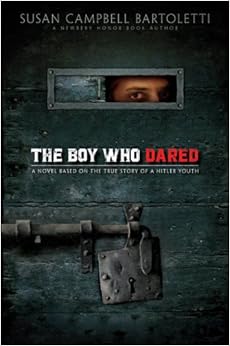
The title of the book I am reading at the moment is called The Boy Who Dared: A novel based on the true story of a Hitler Youth, written by Susan Campbell Bartoletti. The genre of this book is Historical Fiction.


Summary


This story takes place in Luisenweg, Hamburg, 1928. The main character of the book is a boy named Helmuth Hübener, who is 13 years old at the moment of my book. Helmuth is Aryan. He has two older brothers named Gerhard and Hans, and a mother named Mutti. Helmuth has no present father, as well as his brothers. His two older brothers have the same father, while he has a different father. Helmuth is going through a conflict with the Germans and Hitler. Many Germans believe that the reason for families' who are unemployed is because of the Jews. Germans are blaming the Jews, in which affects Helmuth because he has no problems with Jewish people, and he is very religious. Germans call Jews traitors who want to destroy Germany. Adolf Hitler is putting thoughts like those inside the Germans' minds, making almost all the German citizens turn their backs of every Jew known to man.

The mood of this book has got to be sad. Most of the Germans are  criticizing the Jews, and Helmuth doesn't like how this problem is happening because he has a friend who is Jewish. The Jews are losing business due to the lack of customers, because Hitler told the Germans not to shop at Jewish stores. Now, the theme of this book is about bravery. Helmuth shows bravery by standing up to the discrimination of the Jews. He sacrifices his beliefs to Hitler just to protect himself and his family.


Review

I like this book a lot because it is based on a true story about a Hitler Youth. This book shows a perspective from a child who is in Hitler Youth. What I remember most about the book is Hugo Hübener. He is the man that Helmuth's mother had fallen in love with. Hugo was somewhat 'addicted' to Hitler and defended Hitler whenever Helmuth's brother had made a rude comment. To me it was very funny because Hugo has never met Hitler at all, and he thinks Hitler is the coolest most smartest guy of the Fatherland. I recommend this book to teens that have an interest in learning the history about Hitler and the Nazis and how everything worked because this book provides a perspective about a kid who was involved in Hitler Youth. Th viewer of this book talk should go and read this book for many reasons. This book shows you what Hitle Youth is. It'll actually inform you about the days of Hitler and what goes on in that era. For sure the book will open your eyes and make you see German history and Jewish history differently as it did to me. I surely recommend the book to the viewer, but if German history isn't the viewer's type of interest, then it's a loss.

Wednesday, December 21, 2016

Elder Abuse and Human Right Violations: How it Happens and How to Avoid it

On December 5th, 2016, a human right was violated when an elder was abused. Jimmy Llenares, a resident in Maple Avenue, was shoveling his driveway in a cold afternoon, when suddenly three teenage girls threw snow at Jimmy without hesitation. Jimmy was, unfortunately, sad and mad. Of course, he didn’t say a word because he didn’t want to get in trouble. Jaqlyn had questioned him about the incident, and this was his reply verbatim. “On December 5th, there was 3 ladies walking on the alley, while I was shoveling the snow. They throw snow at me! What dah heck?” 

This is a big problem. People should care about violations of human rights and elder abuse, because clearly it could happen to anyone and everyone in the world. They need to know how to stop either the violations of human rights and to stop elder abuse as well. Human Rights is a right that is believed to belong justifiable to every person.The human right that the teens had violated was Article 5: Ban on Torture. This means that no one shall be subjected to torture or to cruel, inhuman or degrading treatment or punishment. The teens violated this human right by throwing snow at Jimmy forcefully and in a cruel way. Everyone has human rights and it is wrong for another human being to violate them. To stop human right violating, people should just mind their own businesses and not do any obscure actions towards other people, especially when the person is an elder.

The teens not only violated Jimmy’s human right, but they also committed elderly abuse. Physical abuse was the type of abuse that the three teenage girls had committed. As mentioned earlier, they threw snow at him. Jimmy is indeed considered an elder, because he is 73. Elderly abuse occurs everywhere. 1 in 10 Americans over the age of 60+ get abused, in which is considered as elderly abuse. Approximately 5 million elders get abused. Physical Abuse means inflicting physical pain or injury upon an older adult. The signs of physical abuse is bruises, pressure marks, broken bones, abrasions, and burns.

Elder abuse, once again, happens anywhere. Based on this article about elder abuse, the author states, “A doctor and judge had recently ruled her mother – by then in her 70s – incapacitated – unable to make decisions for herself. They appointed a legal guardian, shortly before she began her stay at Longhorn Village.But after only a few months of living there, her daughter says she noticed a change in the woman who was once so warm and engaging.’(My mother) became more and more distraught,’ she said.’She talked about wanting to move. She became more withdrawn and upset.’The woman’s legal guardian and family claimed in a lawsuit filed against the facility that she was sexually assaulted twice in 2012 by a male resident described as a’sexual predator.’ Claiming the Longhorn Village failed to protect the woman, the suit further alleged the man’s’sexual activities were known to the administration, but nothing was done to protect his victims.’ “ (Source: http://story.kxan.com/elder-abuse/) This proves that any type of elder abuse can occur to almost anyone anywhere. In this case, it happened to an elder woman at a nursing home. She had been sexually assaulted by a caregiver at the nursing home. This is technically abuse, because unfortunately she has dementia and didn’t exactly know what was going on. To sum it all up, elder abuse and human right violations should be put to a stop.

Thursday, December 1, 2016

Genetic Engineering - Nonfiction Reader Response

The book that I am currently reading is Genetic Engineering by Steve Parker.  This book talks about what genetic engineering is and how everything works. Genetic engineering is when you study and/org examine living cells and their DNA, while experimenting on them. There is a wide selection of living organisms that genetic engineers can experiment on. From human DNA cells to a flowe'rs cell.

A passage that I found interesting in the book is about "What Are Genetic Conditions?", stating, "The  genes for the human body are instructions, not only for the finished body, but for the developing and growing process, too. If there is a tiny fault, such as a missing gene or one which is slightly altered, the body may not be able to develop or work normally. There are thousands of different genetic conditions. Some have little effect on healthy, although they may be noticeable. Examples are a red mark on the skin, called a birthmark, or an extra finger or toe. Other genetic conditions can cause serious healthy problems. If the heart does not develop in the normal way, for example, it may not pump blood around the body effectively." I thought this was very interesting because of how it explained that there are many genetic conditions and the author told me some types of conditions. It was very intriguing to learn more about genetic conditions, so my curiousity searched up more information about the possible genetic conditions.

Some of the things that I have learned from reading this book is about GMO's, Genetic Conditions, and lastly, Faulty Genes.GMO stands for 'genetically modified organisms'. Genetically engineered foods could possibly have a different size and/or a different taste, also even the texture and consistency. Moral of the story, genetically modified foods could be different from the original foods, and could even be the same. Genetic Conditions are, to put it in my own words, abnormality. A genetic condition that I found interesting was about the heart. If the human heart isn't developed correctly due to the faulty gene, it would have a major impact in the human body.

I was surprised when I was really into the book, because usually I don't really read non fiction on my free time, but after reading this book, I may take interest into more non fiction books. Considering the fact that I would like to be in the medical field when I grow up, Genetic Engineering will probably be another suggestion for my future career.


I commented on Dena's Blog
I commented on Kiana's Blog
I commented on America's Blog