Friday, May 26, 2017

This I Believe Speech

I believe that teachers will always find a way to help you in times of trouble when you least expect it. I never realized how much a teacher cared about my education deeply, until I walked into Mr. Jaworsky’s classroom. I was always a troubled teen. I had trouble paying attention in some classes. My teacher and I grew a bond, and that made me realize that teachers will eventually inspire me.

I was sitting in math class, and the room was filled with voices and words I couldn’t seem to hear out but my own, and it was pretty cold. I do admit that I was a distraction to my peers by talking to them instead of doing my assignments, although I didn’t realize that until I had a conversation with my teacher, Mr. Jaworsky. There were multiple times where I had been pulled out of the crowd and out the halls where he had to give me a talk. Sometimes, our talks were very serious to the point where I had teary eyes. I cried sometimes, but not because he pulled me out of class, but because he was right. I can’t exactly remember his words verbatim, but I do remember what he was trying to tell me. Mr. Jaworsky told me that I should never doubt myself. I always told myself I’ll be stupid and I won’t succeed. He told me that I should never plant a negative seed in my brain such as that, because if I do, I’ll become unsuccessful and I will indeed be unintelligent. That was one of the talks out of a hundred. Mr. Jaworsky is one of the greatest teachers that will never give up on you. He will not let you beat yourself down in front of him. He will be the teacher that inspires you to do better, and he won’t let you lower your self esteem. Mr. Jaworsky has seen me at my worst breaking points, to the point where I cried to him. All he wants for my peers and I is to become the best of ourselves. He became personally involved with many of his students. He considered us family. All those times that he told me to not think pessimistic and always strive for success really helped. Mr. Jaworsky tried his very best for me to improve. He called and emailed my parents, he pulled me out of class to talk to me, and he assisted me with nearly everything. The only way I could possibly thank him is to show him that all his hard work on me improving was really worth it.

I’ve came to a conclusion where teachers like Mr. Jaworsky will always want the best for you and will never give up on you. He made me realize that life isn’t over. I can always restart. There really is no ending to success. You. at have trouble finding it because you aren’t trying hard enough.Necessarily, success doesn't come easy. I tried my best, and it may have not seemed like it, but I did take note on what my teacher had told me. I still am trying my best to be a successful daughter, friend, and student. Mr. Jaworsky has changed me completely, and I will never forget him. He will always be in my heart because he is one of the people who inspires me to strive and persevere through my work.

Don’t ever doubt yourself. When you feel like giving up, and when you feel like dropping everything at ease, don’t. Avoid planting negative seeds in your brain. The cynical words you say to yourself will water that seed. Say for an example, you say you’re dumb. Keep on watering it with negativity, and eventually you will be dumb. Do you want to be dumb? No one wants to be dumb. Think positive. Strive for the success. Find who you want to become and work for it. Study for it. Learn for it. Do whatever is takes. It really is never too late. You just have to try and try until you get there. And trust me, you’ll get there.


Wednesday, May 10, 2017

Chernowitz vs. Anti-Semitic Article

Where and how does anti-Semitism happen? This connects to both my chosen article and assigned lit circle book because the theme between these two are similar. Both sources talk about how anti-Semitism is, which people get affected, how they get affected, and where it could all happen. Anti-Semitic teens are all around the world, so both the article and book set an example of where and how anti-semitism is shown.

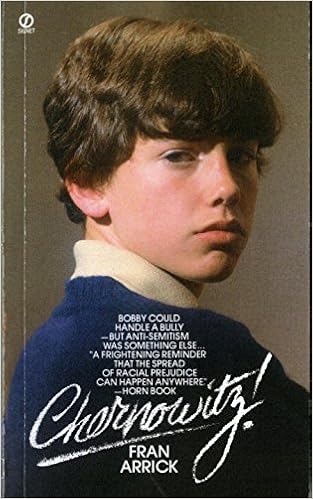
The authors of the book and article sum up anti-Semitism in a similar way, yet it's different as well. In the book Chernowitz!, the author Fran Arrick sets an excellent and unique example of a student facing anti-Semitic 'peers' at school. The main character who's a victim is named Bobby Cherno, and his actions against anti-semitism shows how horrific it can be, especially when it is pressured on a teen. In the book, Fran Arrick states,"I think that in spite of all Sundback's crap, the thing that hurt me the worst was Brian Denny, my 'bestfriend,' who said, as we were getting off the bus at school one morning: 'Move over, Jew bastard, you take up too much room.' It shocked me so much I couldn't breathe for a minute" (61). From the book, this is an example of how a jew teen receives hate from other anti-semitic teens. Getting bulied for being a specific race is horrible as it is, especially when 2 or more people do it. Now, this will date back to the article.

Jefferson Chase, author of article, talks about how a 14 year old Jew experiences high school in the worst way possible just because of his race. This connects to Chernowitz by multiple reasons, one being that there is a teenage boy receiving anti-Semitic hate by more than two other students. In the article, Chase writes, "...'Phillip' (not his real name) transferred from the Gemeinschaftschule in the Friedman district of Berlin to another school after sufffering anti-Semitic abuse. The teenager was subjected to verbal harrassment after revealing he was Jewish. He was also grabbed and threatened with a realistic-looking pistol that later turned out to be fake" (Paragraph 3). Chase shows how anti-semitism can affect teens, especially 'Phillip'. Phillip had to move to different schools because of the harrassment he received from his other peers. It also states, "In May of that year, the Deutschlandfunk radio station recorded students from Muslim backgrounds at one Berlin school saying things like: 'If a Jew enters our school, he'll get beaten up- I'd beat him up too" (Paragraph 19). How come mostly all anti-Semitic students are Muslim in Berlin? That is a question yet to be answered.

In conclusion, both the article and the book tie together due to its strong similarities, and weak differences. The article sets an example of a Jewish teen getting bullied because of his race, and the book Chernowitz sets yet another great example of a Jewish teen getting bullied because of his race. Both are true stories, and both are accurate. The only drastic difference is that in the book, Bobby doesn't move to a different high school after getting verbally harassed, but in the article, 'Phillip' exchanges schools. Bobby didn't really have a choie, but 'Phillip' had an option. This sums up how both the article and the book connect with only a slight significance.


Resources
(www.dw.com), Deutsche Welle. "Anti-Semitic bullying forces Jewish teen from Berlin high school | Germany | DW.COM | 02.04.2017." DW.COM. Jefferson Chase, 4 Feb. 2017. Web. 10 May 2017.

Arrick, Fran. Chernowitz! New York: New American Library, 1983. Print.

Thursday, May 4, 2017

Lit Circle - Chernowitz!

1. Do you like what you're reading? Why or why not?

I'm enjoying what I'm reading at the moment. Chernowitz sends off an important message, notifying us teens that discrimination and anti-semitism will always be around, and how horrible it can be to a person despite the 'humour'. The book is about a 15-year old boy named Bob 'Bobby' Cherno, in which he gets bullied and picked on every now and then by Emmett Sundback and a few other people such as Bobby's old friend, Bryan Denny. Because Bobby is Jewish, Emmett calls him Chernowitz, in relation to Auschwitz, "witz". I really like what I'm reading because the moments in the book make me feel like I am there to experience everything. Things like that usually don't happen in Heritage, so reading this kind of surprises me, and I like surprises. Reading books that have cliffhanging chapters sure does leave me intrigued. I catch myself reading ahead sometimes, which is a good sign for a person like me, and by that, I mean I don't usually read unless the book is critically acclaimed a good book.

2. List 5 major events in order from which happened first to last.

So far in the book, Bobby Cherno is being bullied by Emmett Sundback due to his religion and race. As mentioned in the last paragraph, Bobby is Jewish, so therefore, Emmett has been picking on him and has been calling him nicknames since the last few chapters. Within those times, Bryan and Bobby has been very distant. They used to be best friends, until Bryan started hanging out with Emmett. Bryan followed the crowd of bullying Bobby by being named Jewish, in which created conflict between Bobby, Emmett, and Bryan. The 'beef' between Bobby and Emmett increased when Emmett called Bobby a "kike". A kike is a Jewish person, although being called a kike isn't okay, because it's used as an insult. After those events, Bryan crossed the line when he had told Bobby to move, but in an offensive way, stating, "Move over, Jew bastard, you take up too much room. That is where the line had been crossed, and the perseverance for hope between Bobby and Bryan was crushed.

3. Pretend you are a friend of one of the characters. Write him/her a letter.

Dear Emmett,
 I believe that you should stop harassing Bobby with anti-semitism, the racist name calling, and the bullying. Just because Bobby is Jewish, doesn’t mean you have the right to bully him. It is his religion and there’s nothing you can do about it to change him. Your bullying and harassment resulted a group of people, especially Bobby’s old best friend, Bryan, bullying him as well just for his religion. I do not care if you were ‘just kidding,' I do not care if you were just ‘fooling around’. The words have been hurting Bobby for quite a long time and I just demand you stop it. He lost his only real friend, Bryan, because of you. You may have gotten a laugh out of it, but Bobby didn’t. Quit your actions before I involve teachers and parents. #JusticeForCherno

Friday, March 31, 2017

3rd Quarter Reflections

*In what area do you think you made your biggest improvements in English Language Arts? 

The area in which I have improved in ELA would have to be the way I write my blogs. My vocabulary increased extensively when it comes to blogs. I've noticed that whenever I am writing, I jot down lots of information in which is in relation to whatever topic I am given. When I was writing a blog that was about the book Night By Elie Wiesel, I saw that the amount of space it took was large. I wrote lots of information relevant to the book, so therefore my blog about the book came out successfully. Every time I look back at the blog entry I wrote about Night, I give myself a pat on the back. This may sound a bit silly, but I really love seeing blotches of words in blogs. I feel like whenever I see lots of writing, it's an automatic 3/4. Of course, quality has to come first before quantity, but it's just really satisfying to see lots of writing. As I was saying, I worked really hard on my blog about the book. The book Night changed the way I see the world, and it for sure changed my opinions and my beliefs. It's amazing how much change a book can do to a human dramatically. 

*What is something you have accomplished this quarter that you are proud of?

One thing that I have accomplished in this quarter is my grades in Science. Last quarter, I had an extensive amount of 2's and even one 1. This quarter, I was informed by Mr. Jaworsky that my grades for Science has improved. I received a big fresh 3 in my grades. Of course, I may have some twos, but I can guarantee that I have more 3's than 2's. I am very proud of that improvement because the grades I had received in Science last quarter left me devastated. I knew I had to get back up on my feet and work hard. I did my improvements for not only myself, but for my Mother as well. I knew she was 10x more devastated when I received a 1. She invested all her hard work in my education and I failed her as a daughter. I didn't want her to think of me as a failure. I knew she didn't see me that way, but if I were to be in her shoes, in which I'll never be able to, I would look at my daughter and see her as a failure. I get that a mother should love their child unconditionally, but I was raised differently, in a way that education had to come second. It was serious. So, I did what I had to do. I worked hard. I tried my hardest. I succeeded.


- *What has been the most challenging part of 3rd Quarter for you and what did/can you do to help overcome this?

The most challenging part of 3rd quarter was keeping up this the amount of assignments our class was given in ELA. The numerous amount of assignments in ELA were either finishing up blogs, beginning blogs, reading, and/or doing our Butterfly Project. Hands down, 3rd quarter was tricky for me overall, and ELA wasn't the only class I had trouble with, although ELA was the hardest. What I did to overcome this situation was realize that Mrs. Larson was only preparing the students and I for high school. I realized that I am graduating in 8 weeks. I had to be prepared physically, verbally, and mentally. I knew that Mrs. Larson and my other teachers were doing their job. We had to be prepared and the amount of asssignments tossed at us was a way of showing us 8th graders what it'll be like in high school. I also learned not to complain about the work given to us, because in high school, complaining is not an option. I cannot just sit in my seat, staring in my device, waiting for something to happen. I realized that sitting in a chair doing nothing won't help me go to where I want to go, be what I want to be, and do what I want to do. Heritage Middle School Staff did not work hours and hours just for us to do nothing in life. I could care less if I was tired. If I had homework, I had to do it. In conclusion, I overcame this challenging part of the quarter by having a mindset. I wouldn't be able to do that without the help of my two lovely teachers; Mrs. Larson and Mr. Jaworsky. 

Thursday, March 30, 2017

Life is Beatiful

Between the movie, "Life is Beautiful" and the book, Night by Elie Wiesel, there are many similarities. One of the similarities is that both the book and the movie was taken place during the World War II, and both portrayed life in the a concentration camp. In the movie, the 3 main characters in the movie are named Guido, Joshua, and Dora. Guido is an Italian-Jewish man who marries an Italian-Catholic woman named Dora. Joshua and Dora have a child named Joshua. Further into the movie, Guido, Joshua, Dora, and Guido's uncle Leo get sent to a concentration camp. Dora wanted to be with Guido and Joshua, when she had the chance of staying where she already was. Now, this part of the movie is in relation to the book we've read. Elie and his family are sent to a concentration camp. You've now learned that one similarity is that both families from both the movie and the book has been sent to a concentration camp.

Another similarity is the father and son bond that Guido and Joshua share, and the bond that Elie and his father Shlomo share. Both father and son from both book and movie care for each other so much. They each feed each other food and give each other the love and care they need for their current event. Both fathers and sons get seperated from their mother/wife.

The difference between the book and the movie is the mood/tone. In the beginning of the movie, it was all about humor. Guido was funny in the beginning. The way Guido tried to impress Dora, trying to win her heart was made with humor. Although, throughout the end, there were only humorous moments of the movie, but mostly everything in the end was more of a serious mood/tone. In the book, the whole book was considered serious. Throughout the entire book, I couldn't recall when there was ever a humorous part. There was no jokes aside, no innuendos. It was all serious, and everything was real, and an autobiographic book. Unlike the movie, the book was written by a person who had experienced concentration camps and what it was like.

Life was shown beautiful by the movie in many ways. Life was shown beautiful in the movie because when there was a very serious and a non-forgettable event, Guido made the most out of it for his son, Joshua. Guido turned nearly every serious thing into something funny just for the sake of Joshua. Guido made sure that there was no bad thought of the camp for Joshua. That part of the movie portrayed how you can make the best out of the worst. Another example as to how the movie portrayed that life was beautiful was to chase after someone you love. If you know that they're worth fighting for, chase after that person. In the beginning of the movie, Guido went after Dora, trying to get her attention. Guido never gave up on trying to get at Dora. This taught me that if you love someone so much, never give up on them. Despite your doubts and despite your imperfections in which may seem like that's a blocker, ignore those and chase after that person you love.

Friday, March 10, 2017

Night

       Throughout the book of Night by Elie Wiesel, Eliezer has gone through many changes since the beginning of the book. Eliezer has always been very pious, and was always praying to God, hoping to God, and even believing in God. In the book, Elie states, " 'Why do you weep when you pray?' He asked me, as though he had known me a long time. 'I don't know why,' I answered, greatly disturbed" (Wiesel 2). This specific quote shows how pious Eliezer was in the beginnning of the book. It is shown that he prays, yet he doesn't know why he doesn't pray. Although the point I am proving is that he is religious. In the book, Eliezer then states, "I looked at our house, where I had spent so many years in my search for God; in fasting in order to hasten the coming of the Messiah; in imagining what my life would be like" (Wiesel 16).This quote from the book is another example of how Elie was quite religious. His whole life he has been believing God, respecting God, and even fasting for God to prove his beliefs.  Further into the book, Eliezer loses his faith and beliefs in God. In the book, Elie asserted, " 'Blessed be the Name of the Eternal!' Why, but why should I bless Him? In every fiber I rebelled. Because He had had thousands of children burned in His pits? Because He kept six crematories working night and day, on Sundays and feast days? Because in His great might He had created Auschwitz, Birkenau, Buna, and San many factories of death? How could I say to him: 'Blessed art Thou, Eternal, Master of the Universe, Whose chose us from among the races to be tortured day and night, to see our fathers, our mothers, our brothers, end in the crematory? Praised be Thy Holy Name, Thou who hast chosen us to be butchered on Thine Altar?'" (Wiesel 64). This specific passage is a good example of Elie no longer believing, and/or losing hope, in God. Wiesel questions as to why everyone was preaching God. After everything he and his father and other Jews have been through, he no longer believes in hope and God. Elie then wonders why God had created death factories, let His children die in a cremation chamber, and let Hitler just try to destroy the Jews, and specifically the Jews. After all the devastation that Elie has been put through, he had to question his own beliefs, and question his whole existence. This proves how Eliezer changed his ways since the beginning of the book.
     Another example as to how Eliezer changed throughout the book is how he no longer felt sympathetic for when his Father received beatings from German officers. Eliezer used to care about how his Father had gotten hurt, although he had no other choice but to watch him get hurt. In the book, Eliezer states, "My father was suddenly seized with colic. He got up and went toward the gypsy, asking politely in German: 'Excuse me, can you tell me where the lavatories are?'. The gypsy looked him up and down slowly, from his head to foot. As if he wanted to convince himself that this man addressing him was really a creature of flesh and bone, a living being with a body and a belly. Then, as if he had suddenly woken up from a heavy doze, he dealt my father such a clout that he fell to the ground, crawling back to his place on all fours. I did not move. What happened to me? My father had just been struck, before my very eyes, and I had not flickered an eyelid. I had looked on and said nothing. Yesterday, I should have sunk my nails into the criminal's flesh. Had I changed so much, then? So quickly? Now remorse began to gnaw at me. I thought only: I shall never forgive them for that. My father must have guessed by feelings. her whispered in my ear, 'It doesn't hurt'. His cheek still bore the red mark of the man's hand" (Wiesel 36-37). This shows how much Eliezer has had a drastic change. The way he reacted to major things had changed. Eliezer was surprised himself when he didn't do anything about it, considering the fact that if he were to do something, he himself would have received a hit as well. This occurred throughout the book. Every time Wiesel's father had gotten hurt, he didn't respond physically and/or verbally. Same thing with his father, Shlomo. HIs father couldn't do anything whenever Eliezer had gotten hurt. 

      To sum it all together, Eliezer Wiesel had such a drastic change throughout the whole book. He went from believing in God, to not believing at all. The amount of pain and suffering he had been through had changed his way of seeing life as it is differently. Also, to the point where he and his father were getting punishments and getting blows to the head, they both did not even feel bad for each other. It became a norm for them. It was always happening to the point where they both didn't even defend each other. Eliezer and his father knew the consequences they would face if one of them spoke up to the one who was beating them. In conclusion, Eliezer had changed big time. 


Wiesel, Elie. Night. New York City: Bantam , 1960. Print.


Thursday, March 2, 2017

Butterfly Project


"THE CLOSED TOWN"

Everythimg leans, like tottering,  hunched old woman.

Every eye shines with fixed waiting
and for the word, "when?"

Here there are few soldiers.
Only shot down birds tell of war.

You believe every bit of news you hear.

The buildings now are fuller,
Body smelling close to bosy,
And the garrets scream with light for long, long hours.

This evening I walked along the street of death.
On one wagon, they were taking the dead away.

Why have so many marches been drummed here?

Why so many soldiers?

Then
A week after th end,
A hungry dove will peck for head.
In the middle of the street will stand 
An empty, dirty
Hearse.

--Anonymous


I commented on:

Dena Ahmed

America Guevara

Mario Saucedo

Dylan

Erik Lopez